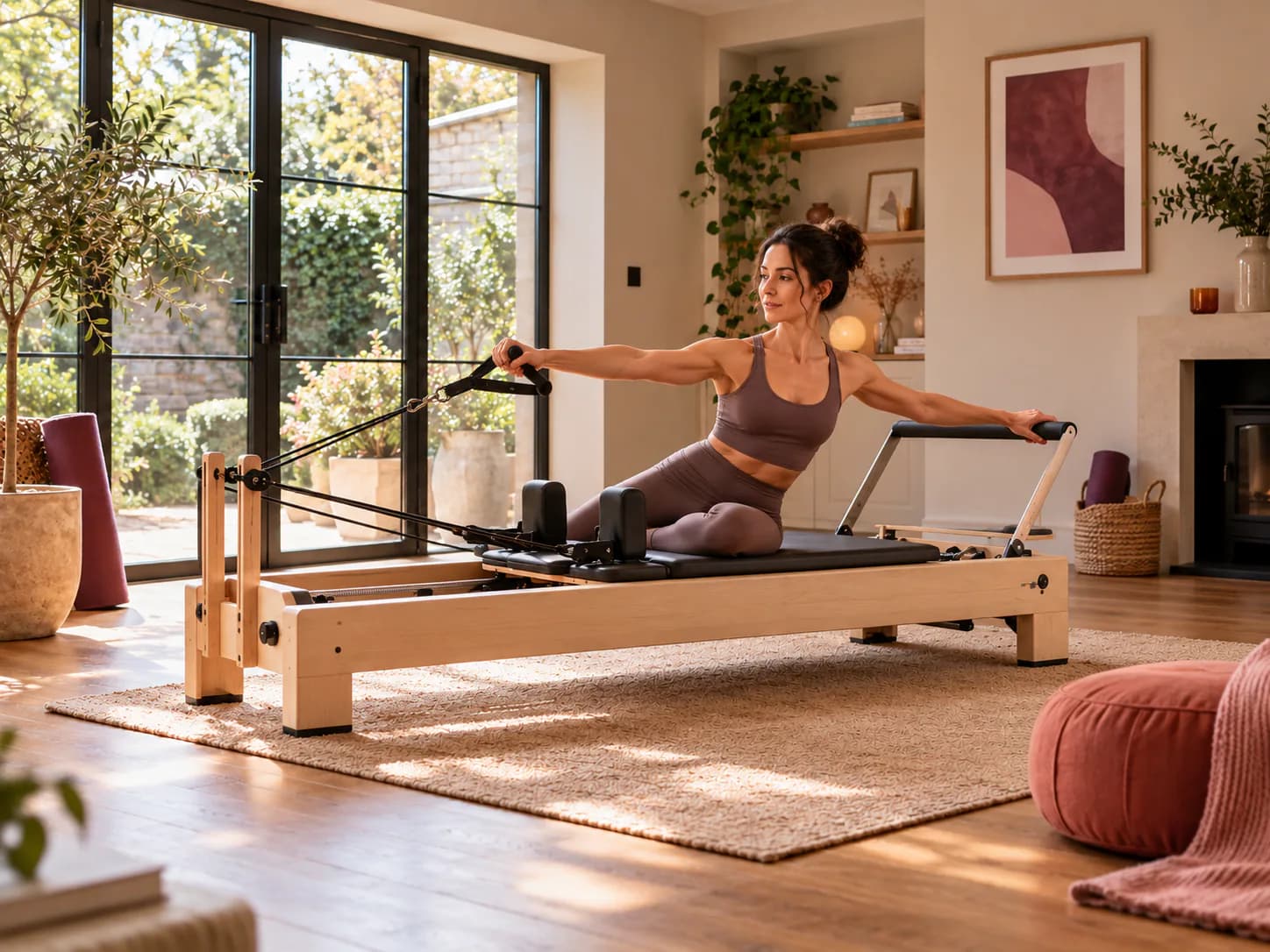
If you already enjoy reformer Pilates, it is easy to imagine having a machine at home. You could step onto it before work, squeeze in a shorter session on a busy day, or stop organising your week around class availability. Those are real reasons to consider buying. They are also only part of the decision.
Convenience is the biggest attraction
Home ownership removes the journey and the booking. It lets you choose when to practise and how long to spend. That can make a routine feel easier to fit in, especially when getting to a studio is the awkward part.
But convenience does not automatically turn into use. Think about what gets you to a class now. Is it the movement itself, or the appointment in your diary, the instructor and the people around you? A machine at home gives you freedom; it does not supply the structure for you.
Give it a real place, not an imaginary one
Measure the spot you have in mind before falling for a particular model. The machine’s footprint is only the start. You need space to get on and off, move around it and use any accessories. Check the manufacturer’s guidance for the model you choose.
A folding reformer can give a room back after a session, but it still needs somewhere to go. Measure the folded size too. Picture the whole routine: moving furniture, opening the machine, practising, then putting it away. If that sounds like a chore, a permanent spot may work better.
Weight matters here. Wheels can help with repositioning on the same level; stairs and carrying are a different question. Check the route from the delivery point to your room as well.
Look beyond the upfront price
Buying a reformer means paying a larger amount at the start. Add delivery, any assembly service, the accessories you want, maintenance and any app or class subscription. A headline price is not always your full ownership budget.
Then think about the classes you would genuinely replace. If you plan to keep going to the studio just as often, a home machine is an extra expense rather than a saving. If it replaces some visits, the balance changes over time. Use your own class prices and realistic attendance, not an idealised week.
Run your own figures through the Class vs Home calculator →Would you use it on an ordinary Tuesday?
Imagine an unremarkable week, not the first week after delivery. When would you use it? What would you follow? Would you be happy practising without an instructor in the room? If you are still learning the equipment, classes and individual instruction may be a better place to build that familiarity.
Home and studio do not have to be an either-or choice. You might value classes for instruction and company, and a home reformer for the gaps between them. The purchase just needs to make sense on that basis.
The right machine matters more than the most expensive one
Start with your non-negotiables: space, storage, resistance system and budget. Then look at carriage dimensions, user-weight limits, included accessories and how you will move the machine. A beautiful reformer that is awkward to set up or too large for your room is unlikely to feel like a good purchase.
If an important detail is not confirmed, ask the retailer before ordering. You should know what you are buying, how it arrives and what is included.
When home ownership may not suit you
- You rely on the appointment and social side of classes to keep a routine.
- You do not have a comfortable place to use and store a machine.
- The upfront cost would stretch your budget.
- You prefer an instructor present rather than practising independently.
- You would have to carry a heavy machine regularly to use it.
So, is it worth it?
It can be, when the convenience solves a real problem and you have the space, budget and inclination to use it. There is no need to rush. Start with a small shortlist and imagine living with each machine, not just owning it.
Plan your space with Room Fit →